

What are the people, groups, places and things that you feel devoted and loyal to - the ones that you would sacrifice something for? Answer that question and I can likely predict your political orientation. While social science research on empathy has found little difference in the amount of empathy expressed by liberals and conservatives, it has found a great deal of difference in where that empathy is focused.
Research seems to show that there’s a psychological difference between liberals and conservatives related to how they feel empathy. Empathy in conservatives is more concentrated, and more limited to things nearer to them, such as family, friends and nations. Liberal empathy is more diffuse and aimed at broader categories such as all people, animals, the world and nature.
Albert Einstein once said, “Our task must be to free ourselves by widening our circle of compassion to embrace all living creatures and the whole of nature and its beauty.”
Compassion is wonderful, but in humans it seems to be a finite resource. Research indicates that when people feel more empathy for things such as the “whole of nature”, the amount of concern they feel for things closer to them declines. Here is a heat map from a 2019 meta-analysis showing the circle of compassion and how liberals and conservatives allotted their moral concern (empathy):
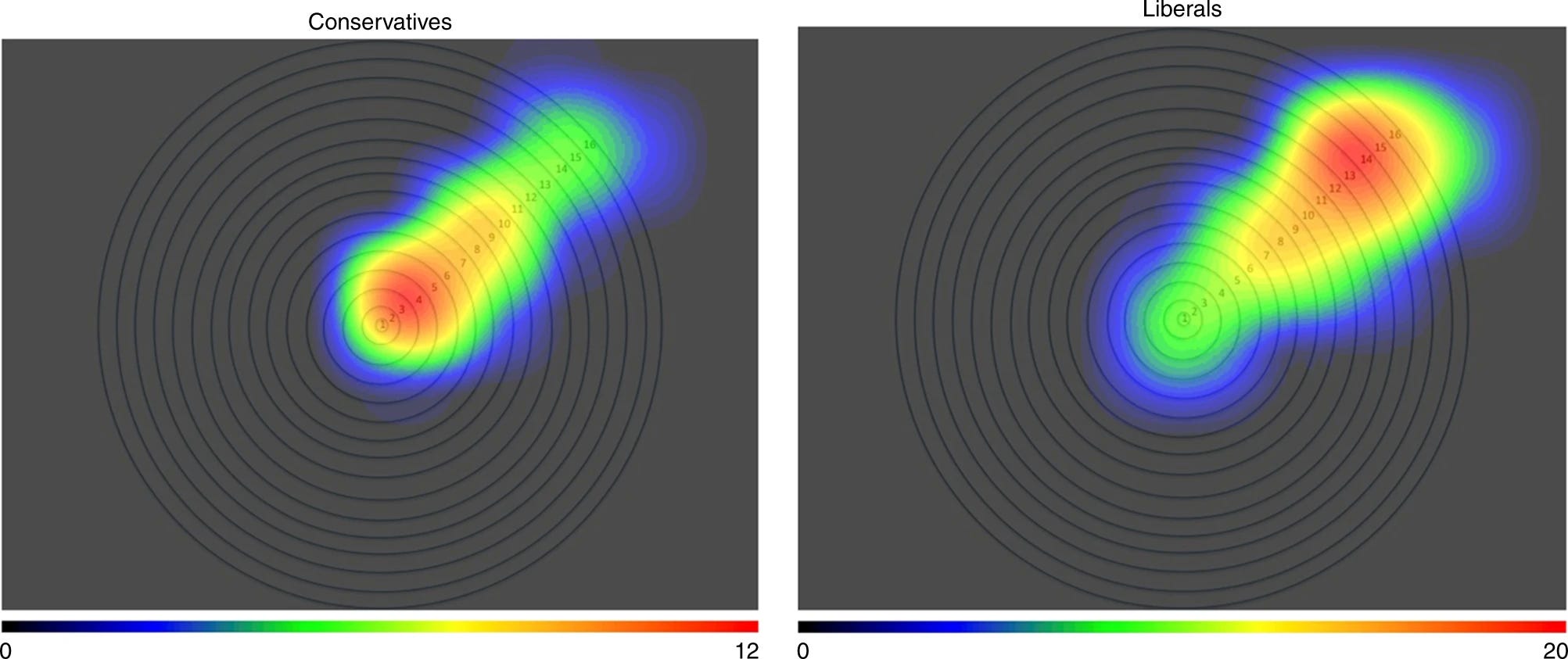
The summary of this meta-analysis explains the psychological differences: “Do clashes between ideologies reflect policy differences or something more fundamental? The present research suggests they reflect core psychological differences such that liberals express compassion toward less structured and more encompassing entities (i.e., universalism), whereas conservatives express compassion toward more well-defined and less encompassing entities (i.e., parochialism). Here we report seven studies illustrating universalist versus parochial differences in compassion. Studies 1a-1c show that liberals, relative to conservatives, express greater moral concern toward friends relative to family, and the world relative to the nation. Studies 2a-2b demonstrate these universalist versus parochial preferences extend toward simple shapes depicted as proxies for loose versus tight social circles. Using stimuli devoid of political relevance demonstrates that the universalist-parochialist distinction does not simply reflect differing policy preferences. Studies 3a-3b indicate these universalist versus parochial tendencies extend to humans versus nonhumans more generally, demonstrating the breadth of these psychological differences.”
I think this pattern is reliable enough that by determining who and what people allot their empathy towards is enough to determine their political psychology, and thus, their ideology.
The current debate over immigration in Europe is a near-perfect example of this divide. People on the conservative side are empathetic with the people closest to them - the Europeans who are victims of violence and sexual assault committed by migrants and affected by radical demographic change. They are much less empathetic towards the immigrants. For liberals, their empathy is more universal and they are more likely to focus on the plight of global migrants from poor countries. Their concern is often with the migrants killed when crossing the Mediterranean (or other dangerous routes) and the difficulties they face building a new life. They rarely express empathy towards the Europeans (who live in relatively rich nations). It is likely that both these groups are equally compassionate, but they are just aiming their compassion at radically different targets. Thus the political divide is more about psychology than it is about ideology.
In a multicultural society this framework can become a little confusing. Consider Minnesota politics. Someone like Tim Walz, who commonly expresses empathy towards Somalian immigrants, might have far different political psychology than Omar Fateh who expresses the same empathy. Walz, who is a midwestern white guy, demonstrates empathy which shows a more universal moral focus, aimed towards the outer rings of the moral circle. Fateh, being a child of Somalian immigrants, demonstrates empathy concentrated on people closer to him in the circle. They are both considered liberals, but that is largely situational. Omar might be considered a conservative via the empathy framework is he were not a minority.
This discontinuity is causing a good deal of confusion in Western politics. Different factions in political parties may share the same targets of empathy, but for radically different reasons. For instance, what values do progressive liberal people in Minnesota who attend gay pride parades actually have in common with religious conservatives from Somalia who require women to wear burqas when in public? I can’t say, but in modern politics, these two groups of people are politically aligned due to their overlapping empathy.
There is a somewhat humorous reccurring theme in news articles, where experts contemplate why immigrants with dual citizenship often vote for liberal parties in the West, but in their home countries vote for conservative parties. The answer seems obvious - they are not liberals. Their moral concern for other people like them simply overlaps with the liberal concern for migrants.
So, given how empathy allegedly differs between liberals and conservatives, how should we act in our modern political environment?
First, ask yourself: who do you love? What are you loyal to? Then align yourself with those who share your loyalties, not people who share your politics, because their motivations and yours might be very different. But, also remember that just because our empathy is limited, there no excuse for denying compassion to those we encounter in our daily lives.